
Monitoring Camp Verde: Power, Privacy, and Accountability
Should the town of Camp Verde stand for the installation of license plate reader (LPR) cameras?
Paul Paine
10/10/20252 min read
Camp Verde:
We Are Monitoring Your Every Move
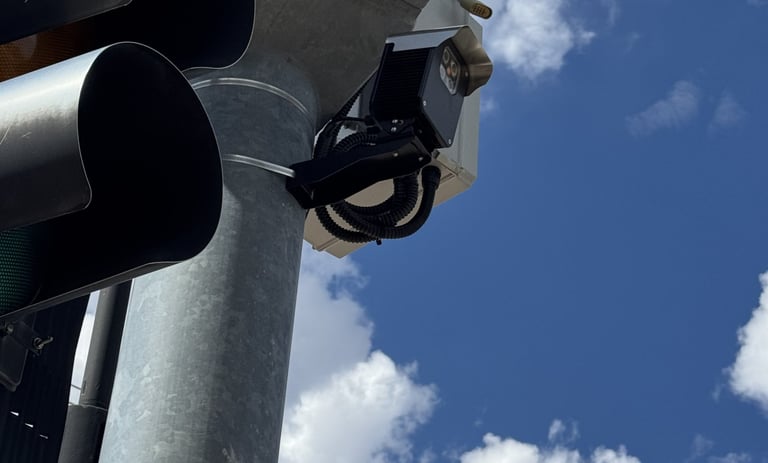
The Camp Verde Marshal's Office (CVMO) recently installed license plate recognition (LPR) cameras in high-traffic areas throughout the town and plans to add more in undisclosed locations. While LPR systems can support public safety and law enforcement, they also raise serious ethical concerns about privacy, civil liberties, and the potential misuse of surveillance data.
LPR cameras capture images of vehicles as they drive by, focusing on the license plate as well as details such as make, model, color, and distinct features like roof racks or decals. Cameras operate continuously, using motion sensors to automatically record images day and night, and then encrypt and upload these images to a cloud, where the data is stored. Customized lists of license plates known as “hot lists” will trigger real-time alerts whenever one of those plates is detected by the cameras. Additionally, all scanned license plates are automatically checked against official watchlists maintained by state police as well as the FBI’s National Crime Information Center (NCIC), facilitating instant notifications to law enforcement when a vehicle associated with "criminal activity" is identified.
Although these systems are promoted as essential tools for modern policing, they also create the potential for broad, unwarranted surveillance of innocent individuals. The constant monitoring of vehicle movements threatens fundamental privacy rights, tracking citizens without their consent, and enabling government oversight at an unprecedented scale.
Orwellian State?
The information stored by LPR cameras can reveal daily routines and personal locations, even when no wrongdoing is involved. This type of pervasive tracking risks creating a society where privacy becomes secondary to control. Programs like these, while framed as safety measures, can easily edge us toward an Orwellian state—one characterized by constant observation and limited freedom.
Even with oversight, one has to ask: Is the pursuit of “security” worth sacrificing the rights and privacy of free people? Should any law enforcement agency be allowed to use such a system without direct public consent?
What Can You Do?
Get the word out by sharing this article. Organize to oppose LPR programs by attending city council meetings, voicing concerns about privacy, transparency, and potential misuse, and urging elected officials to reject or restrict LPR deployment. Public opposition has successfully halted LPR implementations in Sedona; Camp Verde should follow suit. According to the Town of Camp Verde's website, the next town council meeting, scheduled for October 15, 2025, has been canceled. Future council meetings have not been posted at this time.
Chain of Command of the Town of Camp Verde:
Marie Moore: Mayor
Wendy Escoffier: Vice Mayor
Patricia Seybold: Council Member
Robert Foreman: Council Member
Brian Bolton: Council Member
Jerry Martin: Council Member
Jackie Baker: Council Member
Contact the Town Manager:
Miranda Fisher DPA
Email: Miranda.Fisher@campverde.az.gov
Phone: (928) 554-0024
Contact the Marshals Directly
Town Marshal:
Corey Rowley can be emailed at: corey.rowley@campverde.az.gov
Patrol Commander:
Daniel Jacobs can be emailed at: daniel.jacobs@campverde.az.gov
Administrative Commander
Darby Martin can be emailed at: darby.martin@campverde.az.gov
"Those who would give up essential liberty, to purchase a little temporary safety, deserve neither liberty nor safety."
- Ben Franklin
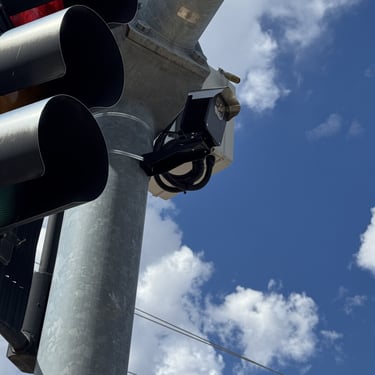
License Plate Recognition (LPR) camera at the intersection of Finnie Flat Rd. and South 7th St.